Many mobile users encounter a common issue:
Your phone shows full signal bars, yet web pages load slowly, videos buffer, and video calls lag.
In reality, mobile network performance is not determined by signal strength alone.
In the telecommunications industry, carriers evaluate network quality using several key performance metrics, including:
- Downlink Speed
- Uplink Speed
- Latency
- Packet Loss
There is also a critical but often overlooked parameter — QCI (QoS Class Identifier) — which determines data priority during network congestion.
Next, Panda Mobile breaks down these metrics and explains how they impact your everyday mobile experience.
1. Network Speed: Downlink vs. Uplink
Mobile data transmission operates in two directions:
- Downlink: Data from the network to your device
- Uplink: Data from your device to the network
Both are measured in Mbps (megabits per second) and represent overall bandwidth capacity.
- Downlink (download speed) affects streaming, browsing, and app downloads
- Uplink (upload speed) impacts video calls, live streaming, and file uploads
2. Network Responsiveness: Latency
Latency refers to the time it takes for data to travel from your device to a server and back — also known as Round Trip Time (RTT), measured in milliseconds (ms).
High latency can result in:
- Noticeable lag in video calls
- Slow page loading
- Delayed responses in online gaming
3. Network Stability: Packet Loss
Data transmitted over the internet is broken into small units called packets.
Packet loss occurs when some of these packets fail to reach their destination.
When this happens, data must be retransmitted, reducing efficiency and stability.
High packet loss may cause:
- Video buffering
- Choppy voice calls
- Failed page loads
4. Network Priority: QCI (QoS Class Identifier)
Beyond speed and stability, network priority plays a crucial role.
QCI is a QoS classification used in LTE networks to define:
- Data priority
- Latency requirements
- Resource allocation
When networks are congested, carriers allocate resources based on QCI levels.
- Lower QCI value = higher priority
- Higher QCI value = lower priority
Think of QCI as a priority lane on a highway:
When traffic is light, everyone moves smoothly. During congestion, higher-priority users get faster access.
Example:
- QCI 7 → higher priority
- QCI 9 → lower priority
This explains why in crowded environments (airports, malls, events), some users experience significantly better performance despite similar signal strength.
Real-World Network Testing Results
To evaluate real-world performance, we tested multiple SIM cards — including Panda Mobile and other carriers — under identical conditions (same location and device).
Results show that Panda Mobile delivers superior performance across key metrics:
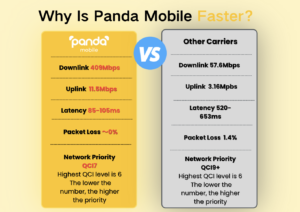
- Download Speed: ~7× faster than comparison carriers
- Latency: ~100 ms vs. 500+ ms on others
- Packet Loss: ~0% vs. 1.4% (e.g., CM Link)
- Network Priority: QCI 7 vs. QCI 9 on some MVNOs
Overall, Panda Mobile demonstrates clear advantages in speed, responsiveness, and stability.
Beyond Performance: A Better Cross-Border Experience
1. No Roaming Fees — True US–China Shared Data
Traditional U.S. carriers often charge high international roaming fees:
- AT&T: ~$12/day
- Verizon: $10–$12/day
- Pay-per-use rates can reach $2/MB
A two-week trip can easily exceed $170+ in roaming costs.
With Panda Mobile’s OnePool™ shared data solution, unused U.S. data remains available in China — with no roaming activation or extra fees required.
2. Not Just “Works” — Actually Usable
Some carriers technically support roaming, but with major limitations:
- T-Mobile often provides only 2G or heavily throttled speeds
- High-speed data is capped (e.g., 5GB / 15GB), then significantly reduced
In other words: usable, but frustrating.
Panda Mobile provides full-speed, practical data performance suitable for everyday use — without relying on throttled fallback networks.
Additionally, users can access U.S. websites in China without requiring a VPN, preserving their normal browsing experience.
3. Free Shipping in the US & China — Stay Connected Upon Arrival
Traditional carriers typically require in-store activation after arrival in the U.S.
Panda Mobile offers free shipping to both China and the U.S., allowing users to receive their SIM card before departure.
This enables true instant connectivity upon arrival, with no need for last-minute purchases or setup.
4. Bilingual Customer Support
A major pain point for many international users is communication.
Traditional carriers primarily offer English-only support, which can slow down issue resolution.
Panda Mobile provides both Chinese and English customer support via WeChat and its website — ensuring faster, clearer, and more efficient assistance.
If traditional carriers answer the question:
“Can I get connected?”
Then Panda Mobile answers:
“How can I stay connected seamlessly across the U.S. and China?”
From network performance (speed, latency, stability, QCI priority)
to cross-border functionality (shared data, global calling & texting)
to user convenience (free shipping, bilingual support),
Panda Mobile delivers a more complete and user-focused mobile experience.
The difference is clear.
Switch to Panda Mobile today and experience fast, reliable, and hassle-free connectivity.